Showing posts with label History of Photography. Show all posts

Monday, 12 April 2021

The camera timeline-A short history of the tools of our trade

Photography is almost two hundred years old. The history of the camera however, dates back long before the first photographs were ever developed. The evolution of the modern camera began with the camera obsucra principle and continued a long path of change that included landmarks such as the daguerreotype, calotypes, dry plates, film and finally, digital imaging. Here is a quick look at how things evolved before our cameras got so advanced.

The camera obscura

The earliest stages of the development of the camera obscura took place in ancient China and Greece. The camera principle basically consists of a device that uses a pinhole, or a lens to project a scene upside down onto a viewing surface. Before the discovery of the actual photographic process, the only way to record what the camera saw was to manually trace everything. Early cameras where the size of rooms and could fit people inside. In 1685, Johann Zahn envisioned a more portable device for the process; however, it would take another 150 years before it would be applied in real life.

Fixing the images

In 1816, a breakthrough came from the French inventor Niecephore Niepce. He coated a piece of paper with silver chloride which darkened when it was exposed to light. The first permanent photograph was made by Niepce in 1826. He then coated a pewter plate with bitumen and exposed it. Bitumen hardens when struck by light. The photograph survives to this day.

Daguerreotypes

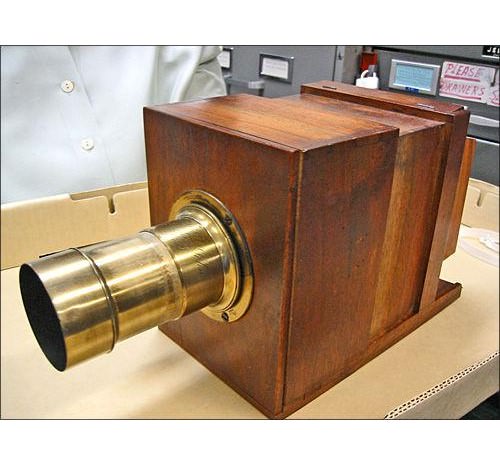
This was the world’s first practical method for photographing. It was invented by Louis Daguerre who partnered up with Niepce. The later unfortunately died before he could see the project completed. The process would probably be considered highly toxic by today’s standards. Daguerre used a copper plate which he coated with silver and made sensitive to light with iodine vapor. The developing was done with mercury vapor and the fixing via sodium chloride, also known as regular salt.
camera timeline 1 image

Daguerreotype camera. Photo source: Camerapedia

The dry plate

In 1871, Richard Leach Maddox invented the gelatin dry plate. For the first time, the wet plate would be rivaled in terms of quality and speed of operation. It was also the first time in history that camera sizes were reduced enough to enable hand held use. You can also view post about the history of photography

There was also significant progress in the use of shorter exposure times. The innovation that gave birth to these new possibilities was the mechanical shutter. Early models were individual pieces detached from the cameras. The built-in shutter first emerged at the beginning the 20th century.

Enter the photographic film

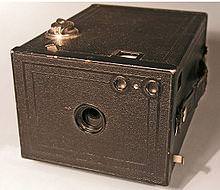
In 1885, pioneer George Eastman began making paper film and he did so until 1889 when progress taught him celluloid was better. The world’s first Kodak camera started selling in 1888. It was a rudimentary box with a fixed focal lens and a single shutter speed, but it had a good price tag and thus became attractive for ordinary users. The film was preloaded into the camera and enabled no less than 100 exposures. Of course, after you exposed the film you had to return it to the factory for developing. The famous Brownie model came out in 1900. It was the camera that gave the concept of snapshot. In fact, it became so popular that it was available for buying until sometime in the early 60s. You can also view photo timeline here.
camera timeline 2 image

Kodak Brownie

Although George Eastman was making history with his portable and affordable cameras, the choice of professionals was still the plate cameras, largely due to superior image quality. Film cameras offered the advantage of multiple exposures and to compete with that, plate camera manufacturers started supplying magazines that would hold several.

The 35 mm film, otherwise known as the Leica format

Oskar Barnack, the man responsible for development at the Leitz Company, wanted to know how useful 35 mm cine film would be for still photography. He also wanted to build a compact camera capable of offering high quality prints. He built this camera, called prototype Ur- Leica, in 1913. Further development was stalled however by the outbreak of WWI. Testing resumed after the war and between 1923-1924, enough positive feedback was received that the company decided to mass produce the Leica I ( for Leitz camera). Because it became an immensely popular camera, competition started to emerge from the likes of Contax and other German manufacturers. The immediate result was an increase in quality of the cameras and the consolidation of the format.

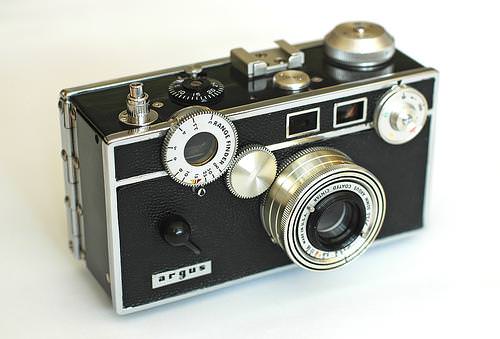
Kodak entered the 35 mm game in 1934, with the introduction of the Retina I. It was the camera that introduced the 135 cartridge used in all modern film cameras. The Retina was inexpensive, but it took a while before the choice of the people would change from roll film to 35 mm. All that would change in 1939 when the Argus C3 hit the market.
camera timeline 3 image

Argus C3. Photo: camera-wiki

It was still not the cheapest camera one could buy, but it put the 35 mm format in top position. The C3 had a long, thriving career until it was finally discontinued in 1966.

The SLR

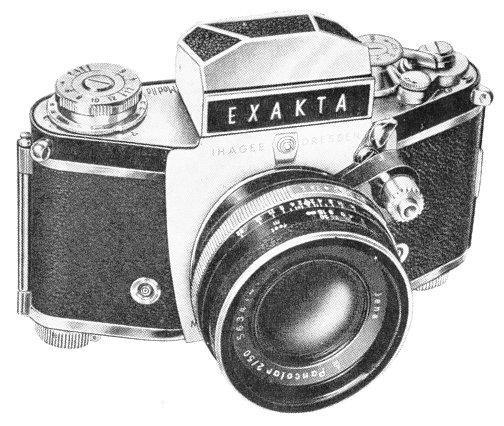
The first single lens reflex camera that was actually practical was the Ihagee Exacta, which was introduced in 1933 and used 127 roll film
camera timeline 4 image

The transition to the 35mm format happened six years later when the Kine Exakta came out. The design of these cameras quickly became popular because they were compact and relatively easy to use. After the Second World War, camera manufacturers massively focused their production on 35 mm SLRs. The first Japanese model was the Asahi (later changed to Pentax) Asahiflex. The rest soon followed and the world massively started enjoying quality cameras from Nikon, Canon and Yashica.

Autofocus and auto-exposure

In 1960, the German Mec 16SB became the first camera to use a light meter for accurate measuring. The more advanced, through the lens system ( TTL) was first used on a SLR by the Japanese company Topcon in 1962, on their model RE Super.

The word’s first mass produced camera to use autofocus was the simple, compact Konica C35AF introduced in 1977. The Polaroid SX-70 OneStep was the first SLR to incorporate autofocus.

The digital revolution

The idea of digital photography goes back to the late 60s. However, the first recorded attempt to build a digital camera was in 1975 and belonged to Kodak engineer Steven Sasson. The camera he designed had a CCD sensor, weighed 8 pounds, and recorded 0,01 megapixel images on compact cassette tapes. This was the first sign that film would eventually be replaced, but of course at that time everybody ignored it, especially since this was only an experiment that wasn’t designed for mass production. You can also check post about when were photos invented.

Fast forward to 1988, when Fuji produced the first, true, digital camera, the DS-1P which recorded on an internal 16MB memory card. It was never sold in the US and there is also insufficient proof that it was available in Japan. The first commercially available camera came out two years later and was called the Logitech Fotoman. It had a CCD sensor, digital storage and could connect directly to a computer.

The development of the JPG format helped the transition from traditional, physical photography to digital capture and storage.

In the professional market, Kodak broke the ice with the DCS-100. It was a gigantic storage unit that had a 1, 3 megapixel sensor and at that time was priced at $13,000.

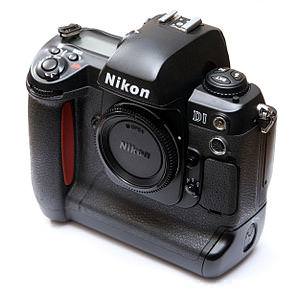
The first, real, fully developed by one company DSLR in the world was the Nikon D1, introduced in 1999.
camera timeline 5 image

It has the standard F-mount, a 2,7mpx sensor and it changed the world of professional photography forever. Of course, now you get 4 times that resolution with your smartphone.

This article about "The camera timeline-A short history of the tools of our trade" was first published on our website here https://www.photographytalk.com/photography-articles/3079-the-camera-timeline-a-short-history-of-the-tools-of-our-trade

Sunday, 11 April 2021

The “decisive moment” is history

The term was introduced by one of greatest masters of 20th century photography ( big round of applause) , the distinguished Henri Cartier Bresson. In his own words, “ the decisive moment is the simultaneous recognition, in a fraction of a second ,of the significance of an event as well as the precise organization of forms which gives that event its proper expression.” This quote is more than fifty years old. Photography has come a long way since. The principles are the same and great images will always have the attribute of timelessness, but things have changed. Learn more about photography history on our website PhotographyTalk.com.

12669482 s image

I stumbled upon an interview with photographer and director Vincent Laforet. He’s the kind of guy Canon call to shoot a promo video with their latest camera. He also has, I believe, a great insight on what the future will bring for this industry. According to him , it’s some sort of a convergence between photography and video. It didn’t make much sense when I first came across the idea, but after some time of linking thoughts, all that might not seem so science-fiction.

Back to the decisive moment, Laforet says “the one thing that’s going to make me miss or succeed as a photographer is capturing “the” moment, because that involves anticipation and predicting the future”. Fifty years ago , being a good photographer meant that you had to be a master of exposure, manual focus and a pretty decent chemist. But none of that would have done any good if you didn’t have the ability to click the shutter at exactly the perfect moment. Meanwhile, autofocus and auto-exposure were born, film died and pixels prevailed. And now, for the first time, there is actual talk about the possibility of extinction of classic, click the shutter to take the picture, photography. As Laforet himself points out, nowadays he can pick any 14 mpx still frame from a movie shot with his 5k, 96fps Red Epic camera. I thought to my self wow! It seems like only yesterday my 6mpx Nikon D50 was badass.

Shooting everything in video and picking the right frame would absolutely kill the need for anticipation, waiting and having the impulse to click the shutter at exactly the right time. That would be a disaster I thought. Everyone is going to be empowered to capture incredible moments and none of us will ever be special again. Then I had a gruesome revelation : the decisive moment has been dead for many years now. Precisely since the creation of the motorized film advance for analog SLRs. Up until that time, if you were, let’s say a sports photographer, you probably would have enjoyed loads of respect from the rest of the shooters in other branches. That would have been mainly because you had to be an artist at know exactly when the pass would be made or when the ball would enter the hoop. Then came along 2,3,5 frames/second. Aaaand, it was gone.I’m not saying it’s easy to be a sports photographer today. It still takes a great deal of effort and skill and I have loads of respect for all those guys However, it’a lot easier to get the shot with a 12fps machine gun like the D4. With all this in mind, I really don’t think there’s a great difference between Laforet’s Red and my friend’s D4. If want you to capture happens in 1/60th of a second, you will definitely get it.

I’m not sure about the prospect of this convergence Laforet speaks of. What I do know is, the required skill set in this industry is constantly evolving. With technical aspects no longer being an issue for anyone, evolution will naturally take place other areas. If you had to be a good chemist back then, you have to be good in front of a computer today. If your ability to capture the right moment is no longer making you stand out from the crowd, maybe you should shift your talent to editing skills. Time will tell.

There is one thing that I don’t believe will ever change. That is the human ability to capture or tell a good story and create something that will cause a spark in anyone watching, no matter if it’s a still frame or a video.

This article about the topic "The “decisive moment” is history" was first published on our website here https://www.photographytalk.com/photography-articles/3038-the-decisive-moment-is-history

Monday, 5 April 2021

14 Turning Points in the History of Photography

 It's easy to forget sometimes that in the grand scheme of things, photography is a relatively new art form.

That's compared to other artf orms like sculpture and painting, and that's certainly compared to the earliest art forms like cave paintings that date to thousands and thousands of years ago. Do you know when was the camera invented?

To say that photography has changed a lot in the last couple of centuries is certainly an understatement.

Here are 14 moments that have shaped and changed the world of photography in one way or another.

The First Permanent Photo

heliograph image By Joseph Nicéphore Niépce [Public domain], via Wikimedia Commons

When talking about the first fixed image created by a camera, that credit is given to Joseph Nicephore Niepce. Learn more about the history of photography on our website PhotographyTalk.com.

His tool of choice was a camera obscura that was fitted with a plate coated in pewter. That plate was exposed for a whopping eight hours, creating an image of Niepce's view of the courtyard outside his home, shown above. The image, taken in 1826 or 1827, was titled View From the Window at Le Gras.

Once the exposure was complete, he used a mixture of white petroleum and lavender oil to render the photo in a process he would later call heliography.

The Daguerreotype

Daguerreotype Daguerre Atelier 1837 image Louis Daguerre [Public domain], via Wikimedia Commons

The next step in the evolution of photography was the development of the Daguerreotype process, which was invented in 1829 by French painter Louis Daguerre. Do you know when was photography invented?

Daguerre worked with Niepce to figure out a way to reduce the incredibly long exposure that was needed to get an image using the heliograph process.

Eventually, Daguerre solved the problem by using copper plates that were coated in silver instead of using the pewter-coated plates Niepce used.

The shorter exposure times resulted in a much more subtle image, but by using a chemical mixture, Daguerre discovered that he could develop the latent image into one that was actually far more visible.

Though he perfected the process throughout the 1830s, it wasn't until 1839 that Daguerre revealed his new method of photography to the world.

His photo, L’Atelier de l'artiste, shown above, was taken in 1837.

Light-Sensitive Paper Makes Its Debut

calotype thomas duncan min image Hill & Adamson [Public domain or No restrictions], via Wikimedia Commons

Merely weeks after Louis Daguerre made his photography breakthrough known to the public, Fox Talbot, a British scientist, released news that he had devised a process of photography that relied not on metal plates, but on light-sensitive paper. You can also check when did photography start.

Talbot had been working on the process for years, but it wasn't until the late 1830s that he discovered, by accident, the right chemical mixture needed to turn the paper into a negative that could in turn be used to make prints.

In 1841, he went public with his work, calling it the calotype process. One of the earliest known calotypes (circa 1844), a portrait of Thomas Duncan, is shown above.

Documentary Photography is Popularized

Valley of the shadow of death image Roger Fenton [Public domain], via Wikimedia Commons

In 1855, Roger Fenton was sent by the British government to document the events unfolding in the Crimean War.

That action resulted in Fenton being the first war photographer in the world, and one of the first documentary photographers used to immortalize world-changing events in the field.

As photographers covering the American Civil War would find out just a few years later, creating photos in the field was a laborious process that required a wagonfull of equipment and a mobile darkroom.

Likewise, even though exposure times were lightning fast compared to the heliotype, they still weren't fast enough to capture action. You can also check another post about when were photographs invented.

As a result, Fenton photographed still portraits and landscapes, and never photographed soldiers that were injured or had died in battle. His photo above, taken in April 1855, is titled Valley of the Shadow of Death.

The First Commercially-Licensed Photos

In 1859, Jean Francois Gravelet (who performed under the name Charles Blondin) drew a crowd of thousands to the border between the United States and Canada to watch as he attempted to cross the Niagara River on a tightrope.

Dispatched to the scene was William England, who at the time was serving as the London Stereoscopic Company's chief photographer.

England's images immortalized Gravelet's 1100-foot walk across the tightrope in a series of stereoscopic images that were among the first to be internationally licensed for commercial use.

Roll Film is Born

After Kodak introduced the first simple-to-use publically available camera in 1889, George Eastman debuted transparent nitrocellulose film that came in rolls.

Eastman's film rolls were in 70mm format, which Thomas Edison cut right down the middle to create a 35mm of film.

Edison also cut perforations down both sides for easier advancement of the film from one frame to the next.

Photojournalism Emerges

secondboerwarthiele image By Thiele, Reinhold [Public domain], via Wikimedia Commons

Where Roger Fenton's portrayal of the Crimean War was "toned down" a bit and excluded the human toll that the war was taking, Reinhold Thiele took no such approach.

After covering joyous events in England - among them Queen Victoria's Diamond Jubilee - and perfecting his photojournalistic approach to photography, he was sent by the London Daily Graphic newspaper to document the Second Boer War. Learn more about where was photography invented on our website PhotographyTalk.com.

But upon receipt of his images, the paper refused to print many of them due to their graphic nature and portrayal of the carnage that was occurring.

As a result of the manner in which he documented events in a realistic manner, Thiele is considered one of the fathers of photojournalism.

The 35mm Standard Opens Photography to the Masses

Ur Leica min image By Leica (Leica Microsystems (früher Ernst-Leitz)) [CC BY-SA 2.0 de (https://creativecommons.org/licenses/by-sa/2.0/de/deed.en)], via Wikimedia Commons

Oskar Barnack, a German engineer and amateur photographer, had a problem.

His camera gear was way too heavy, especially in light of his poor health.

He wanted to lighten his load by designing a smaller film camera that was easily transported.

In 1913, he created his prototype (shown above), a 35mm still camera that used existing 35mm film for movies.

Over a decade later, in 1925, Barnack's camera became available to the public under the brand name Leica, making photography accessible to anyone who could afford it.

The rest, they say, is history!

Instant Photography Makes Its Debut

landcamera min image By OppidumNissenae (Own work) [CC BY-SA 4.0 (https://creativecommons.org/licenses/by-sa/4.0)], via Wikimedia Commons

Using a process called diffusion transfer, American physicist Dr. Edwin Land created a camera that could take, develop, and print a photo.

The process required film that was both the film and the photo, which resulted in virtually instant photographic gratification.

His Land Camera - the Polaroid Model 95 shown above - became available in 1948, ushering in the instant camera craze the Polaroid would make famous in the decades to come.

Magnum Photos is Formed 

One of the most influential photographers of the 20th Century, Henri Cartier-Bresson, started his photography career in earnest in 1947 when he started Magnum Photos, one of the most well-respected photo agencies of the time.

Cartier-Bresson had a gift for depicting both the triumph and tragedy of human life. In his book, The Decisive Moment, he offered up 20 years of documentary images that gave people a glimpse at the best and worst in people.

He also famously photographed the likes of Gandhi, Marilyn Monroe, Che Guevara, and many other influential figures of the time.

Digital Photography Revolutionizes the Industry

If you asked someone when digital photography became a thing, it's doubtful they would say 1974.

Yet, that's the year that Gareth Lloyd, a worker at Kodak, questioned the possibility of using a semiconductor to create an image sensor for a camera and asked Steven Sasson, an electrical engineer, if it could be done.

In 1975,  Sasson had what they wanted - a digital camera that converted image information into an electronic signal to be stored in the camera's onboard memory.

It was a huge camera, weighing in at eight pounds, and its images were a paltry .01-megapixels.

However, it was the start of a revolution of which we are still experiencing effects today.

The First Commercially Available Digital Camera

768px Early digital image By John (Flickr: Early digital!) [CC BY 2.0 (http://creativecommons.org/licenses/by/2.0)], via Wikimedia Commons

In 1991, Kodak released the first widely available digital camera, the Kodak DCS-100.

It had a 1.3-megapixel sensor in a modified Nikon F3 body and an external memory storage unit (shown above) that had a 200-megabyte capacity. That was good enough for 156 uncompressed images!

It was spendy, though. At $13,000, it certainly wasn't a massive success, with less than 1,000 units sold.

However, it ushered in the modern era of photography that we all enjoy today.

Photographers Get to GoPro

gopro35mm image

Even as digital photography was becoming more and more ubiquitous in the late 1990s and early 2000s, there was still a problem...

As Nick Woodman discovered in 2002 on a surfing trip, it was difficult for amateur photographers to get high-quality action shots because the camera gear needed to do so was so expensive.

Later that year, he founded GoPro to solve that problem.

In 2005, GoPro came out with its first camera, the GoPro Hero 35mm, which you can still find floating around on places like Amazon.

The camera came with a roll of Kodak 400 film, a clear waterproof case to protect the camera to a depth of 15 feet, and a camera strap to help photographers get those elusive action shots.

The iPhone Arrives

536px IPhone 1st Gen.svg image By Rafael Fernandez (Own work) [CC BY-SA 4.0 (https://creativecommons.org/licenses/by-sa/4.0)], via Wikimedia Commons

Sure, there were plenty of phones that had a camera before the arrival of the first-generation iPhone in 2007.

However, in terms of having an iconic place in the development of smartphone photography, the iPhone is at the top of the heap.

It was equipped with a single, rear-facing camera that sported just 2-megapixels. You can also check another post about when was the photograph invented.

However, the easy-to-use touchscreen interface on the phone made it quick and easy to snap and share photos.

When the App Store was unveiled a year later in 2008, smartphone photography took another leap forward with the advent of being able to add supplemental features to the phone to take better photos, like improved camera apps, photo processing apps, and the like.

At the time of this writing, we're awaiting the arrival of the iPhone X, a phone that has a 7-megapixel front-facing camera, a infrared front-facing camera for face detection, a 12-megapixel rear-facing camera with both wide-angle and telephoto lenses, and a host of other features that certainly would've been unimaginable to the likes of Niepce, Daguerre, and other pioneers in the field of photography.

To say that we've come a long way is an understatement!

This blog post about the topic "14 Turning Points in the History of Photography" was first published on our website here https://www.photographytalk.com/photography-articles/7980-14-turning-points-in-the-history-of-photography